
Finding the Monterey Residents Directory
Let the first clue set the route in any Monterey resident lookup. An address is the strongest opener. It points to the Monterey County Parcel Report and an APN, the assessor's parcel number. That number then opens the Property Value Notice system and a recorded-document index. A name works differently. Test it against court party fields, business filings, professional-license records, or library directories. A target year changes the source again. Haines begins in 1970, the California History Room's city-directory run spans 1905-1987, and public census material reaches 1950.
These sources describe different relationships. A deed names parties to an instrument, a parcel identifies land, a directory prints a listed household, and a court case assigns a party or role. Monterey sits inside Monterey County. Many records for a resident trail are kept in Salinas, so plan the trip or the mail request around it. A name result is only a lead. Two independent details, such as an address and a date or an address and a record role, beat a name alone every time.
- Start with an address in county GIS. Record the APN, legal description, subdivision, and any current document number or date.
- Use the APN or assessment number in the Assessor's Property Value Notice search for the property facts the public interface supplies.
- Move to the Recorder's current or historical index for deeds, liens, maps, and named transaction parties. Test spelling variants.
- Use the court portal, business and license searches, or the authenticated voter-status tool only for the narrower question each source can answer.
- For an older household, ask the library for directories, reverse books, newspapers, census material, or registers; use the custodian, mail, counter, archive, or CPRA route when the web trail ends.
Monterey's Resident Records Offices
Land records in Monterey County begin with the Assessor-County Clerk-Recorder. The office keeps two indexes that together span the whole county era. The Historical Official Records Index covers 1850 through 1977. The current Official Records Index picks up from 1978 to the present. That reach is rare. The counter sits at 168 West Alisal Street in Salinas, open Monday through Friday from 8 to 5. Mail goes to PO Box 29. Phone help is at 831-755-5041. Peninsula callers can dial 831-647-7741. Copies run $2 per page, and certification is $2 per document. Remember that an index only points the way. A certified copy or page image is a separate request.
The Assessor side works differently. Parcel lookup is separate from any public browse of owner names. The Property Value Notice route takes a fee parcel number or assessment number. The GIS Parcel Report can find a parcel from an address or an APN. County Elections offers the public-facing My Voter Status tool as an authenticated self-check rather than a general roster. All three desks can sit along one research chain for a Monterey resident lookup. Yet none of them disclose the same people or the same facts.
Monterey County Recorder
168 West Alisal Street
Salinas, CA
Mail: PO Box 29
831-755-5041
Official Records Index
Monterey County Assessor
Parcel and assessment search
APN-based public interface
Ownership and value fields vary
831-755-5035
Property Value Notice
Monterey County Elections
Voter status self-service
Qualified-purpose file requests
Phone and email application support
831-796-1499
My Voter Status
Monterey APN Search Starts With GIS
The county's open GIS Parcel Report is the practical starting point when no owner-name search exists. Its address or place locator accepts a street address. Its parcel tool takes an APN or APN_FORMAT value. Selections can run by point, line, rectangle, circle, polygon, or freehand shape, and the map then produces parcel reports, measurements, layers, filters, exports, and an attribute table. One cap applies. A selection stops at 2,000 records. The open layer also omits owner and mailing-address fields, so a map result is never a resident list.
Once GIS supplies an APN, move that number into the Property Value Notice system. The Assessor accepts 12 digits or at least six partial digits, typed without punctuation or spaces. The result can lead to ownership, parcel status, TRA, assessed values, exemptions, and characteristics. The public interface still lacks an owner-name search. A residential characteristics report costs $24. A map print costs $3.
| Search field | Input | Required | Monterey format and result |
|---|---|---|---|
| Fee parcel number | Numeric text | One search key | Enter 12 digits, or at least six partial digits, with no punctuation or spaces. |
| Assessment number | Numeric text | One search key | The Property Value Notice route is keyed to the assessment number rather than a public owner-name browse. |
| Address or place | GIS autocomplete | One locator | Finds a place or parcel; the locator supports up to six matches in the address workflow. |
| APN or APN_FORMAT | APN text | One locator | Partial matching is available in GIS, with up to six matches in the parcel search. |
Keep the APN, legal description, and jurisdiction together. City and Jurisdiction fields matter just as much. An APN survives a street-name change better than plain address text, and those fields separate Monterey proper from a mailing address that only borrows the Monterey postal city. The full by-address workflow lives in Monterey's By Street directory.
Monterey Deed Records Trail
Monterey land research starts with the Recorder's index. The current index reaches from 1978 to the present, and a historical index covers 1850 through 1977. Searches run on exact party name, document type, and date range. Save each hit's document number or reel and page. Every deed names two sides. The grantor conveys an interest; the grantee receives it. Running an earlier deed's grantee as a buyer pulls the ownership chain back another step.
When the online index runs dry, the counter in Salinas keeps the trail open by phone or by mail at PO Box 29. A copy request needs specifics. Supply a document number or reel and page, the recording year, at least one exact party name, and the document type. Copies cost $2 per page, and certification adds $2. Parcel research has a second shelf. Surveyor parcel maps, subdivision maps, records of survey, and corner records date to 1850. They steady a chain when a parcel split, merger, or changed street name hides a deed, and they pair naturally with directories when you trace past residents rather than assuming a deed party stood for a whole household.
A recorded document carries a rich inventory of fields. Expect a return-mail party, APN, recorded date and time, title or page count, fees, taxes, amount, grantor, grantee, and the legal description. That inventory tells you what a result can prove. It is no complete Monterey residents directory. A deed party is not proof that an owner occupied the premises, so pair the land trail with street directories when tracing past residents of Monterey.
Current Monterey Residents Directory Sources
Several current sources look like directory stand-ins for Monterey. Each one answers a different question. GIS pins down parcels with document and district clues. The Assessor keys property facts to an APN. The Recorder names parties to recorded instruments. The court portal names case parties and businesses. Haines, printed and held at the library from 1970 to the present, offers address-to-occupant listings and later reverse-phone clues. Yet none of these is a complete list of every person at an address.
| Source | What it can show | Keeper | Access path |
|---|---|---|---|
| Parcel Report GIS | APN, parcel geometry, legal and district clues | Monterey County GIS | Free locator and map tools; open layer omits owner and mailing data |
| Property Value Notice | Ownership, values, exemptions, characteristics tied to an APN | County Assessor | Free APN or assessment search; $24 report and $3 map options |
| Recorder indexes | Named parties to deeds, liens, and other instruments | County Recorder | Online index, Salinas counter, phone, or mail |
| Superior Court portal | Case number, name, business, status, filing date, and type | Monterey Superior Court | Free remote portal without login; courthouse terminals show more |
| Haines reverse directories | Listed adult at an address and, in later volumes, reverse phone clues | California History Room | Noncirculating library collection, 1970-current |
| Voter status | One voter's own registration status and election details | California Secretary of State | Authenticated self-lookup; broader files require a qualified purpose |
Match the source to the question. A parcel unlocks land facts. A court index leads to a case. A directory is a dated printed listing, and voter status is a self-check. For a one-person match, combine two independent fields through a Monterey resident search workflow instead of merging unlike records.
Monterey Court Case Lookup Fields
The Monterey Superior Court Public Portal needs no login. Case Number, First Name, Last Name, and Business Name searches all work there, with minimum lengths of five characters for a case number, three for a first name, four for a last name, and four for a business name. An asterisk serves as a wildcard. General current and completed case coverage starts in 2008, and criminal electronic information reaches back to November 1992. Remote results display case number, case name, status, filing date, and case type.
Remote access is only one channel for court records in Monterey. Courthouse computers open up indexes, calendars, registers of action, and records the public portal does not display. Minute orders in civil, family, and probate matters from proceedings on or after July 9, 2012 can be viewed in the court viewing room. A clerk searching an unknown case name costs $15 per name or for work past ten minutes, and copies cost $0.50 per page. The CI-115 search-and-copy form handles mail or in-person requests for civil, family, and probate files at 1200 Aguajito Road, Monterey, CA 93940; payment goes by check or money order with a self-addressed stamped envelope enclosed. Certification, exemplification, dissolution certificates, and off-site retrieval carry separate charges. Adoption, paternity, juvenile, sealed, mental-health, and many family records remain restricted.
The Monterey Superior Court Public Portal displays the name, business, and case-number fields that shape a resident lookup.
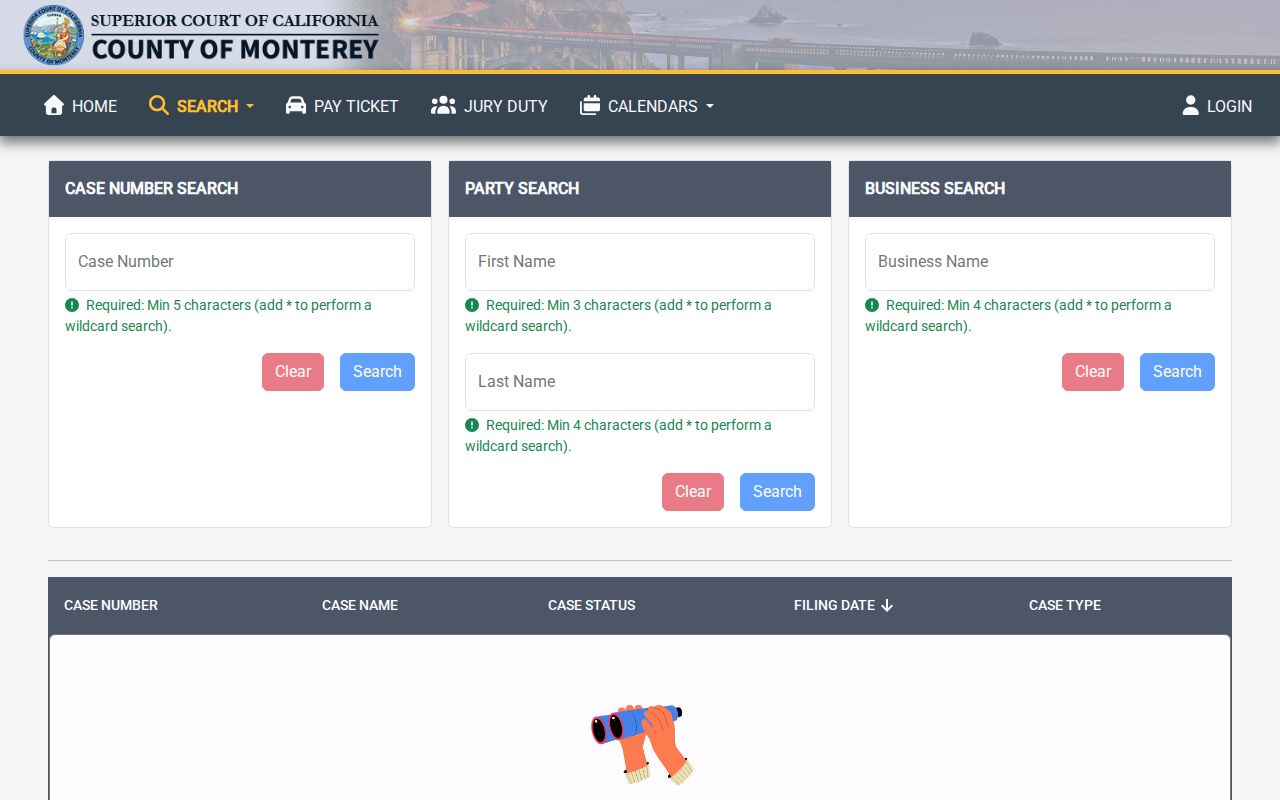
The court search has its limits. It confirms a case role, not a current home address. When remote results are absent, the in-person terminal, clerk search, mail request, and historical-file channels carry the Monterey lookup forward.
| Portal field | Minimum | Search note | What a result provides |
|---|---|---|---|
| Case Number | 5 characters | Use the known case identifier; wildcard is available. | Case number, name, status, filing date, and type |
| First Name | 3 characters | Test spelling and asterisk variants when permitted. | Matching case parties and case details subject to remote rules |
| Last Name | 4 characters | Use a narrow surname and confirm the case context. | Party or case-name matches |
| Business Name | 4 characters | Useful when the record names an entity instead of a person. | Business-linked cases and case status |
Monterey Voter Status and Resident Privacy
California My Voter Status verifies one record: your own. It is no public resident directory. The match needs first and last name, date of birth, and a California driver's license or identification number, or the last four digits of a Social Security number. Results cover registration status, party preference, county, polling or ballot information, and election details for the person checking. Protected voters never appear in public files.
The broader voter file moves through a different channel. Monterey County's application asks who is requesting, the organization, intended use, security steps, extract geography, delivery method, and specific voter or voting-history choices. Processing runs about 2-3 business days. The price is quoted after the request. Contact runs through 831-796-1499 or MCEData@countyofmonterey.gov. State and county files serve qualified purposes under Elections Code §§2188 and 2194, and historical registers at the library reflect limited electorates rather than a population census.
The official My Voter Status form is a self-service check, not a public-name index.
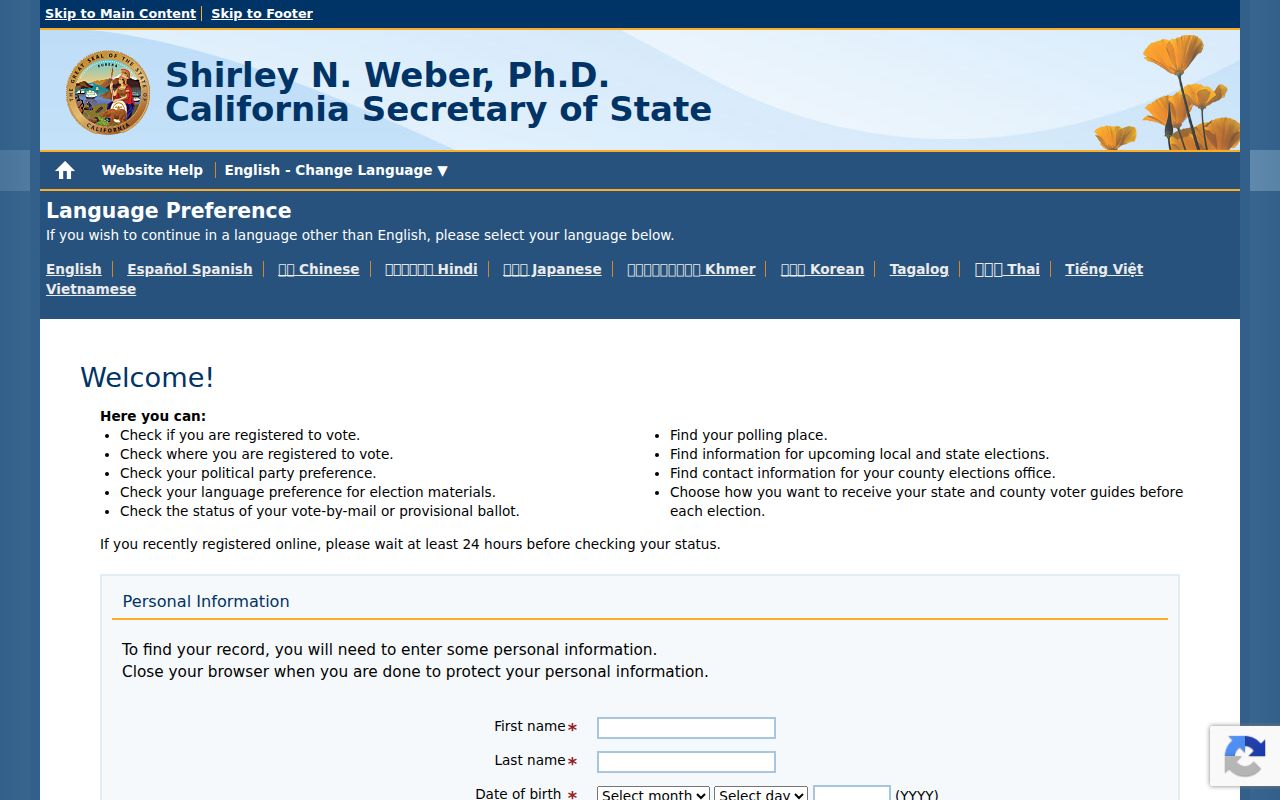
That distinction matters. The personal check stays separate from a qualified-purpose file request. It also means a missing voter result is no evidence that a person never lived in Monterey.
Monterey Vital-Record Lookup Paths
Vital records in Monterey County split by how old the event is and what type of record you need. Monterey County Health is on the second floor at 1270 Natividad Road in Salinas. It keeps the current year plus one prior year of births and deaths. The counter is open Monday through Friday from 8:30 to 4:30, closing noon to 1. The phone is 831-755-4504. In-person orders can be while-you-wait, with cash, check, or card accepted. Older county births and deaths move to the Recorder at 168 West Alisal Street or PO Box 29. County marriage records also route through the Recorder. The state CDPH is the statewide custodian.
County fees for 2026 are $31 for a birth certificate. A death certificate is $26, and a marriage certificate is $19. California treats authorized certified copies and informational certified copies as distinct under Health and Safety Code section 103526. Mailed authorized-copy applications require a notarized sworn statement. Payment must be by check or money order, but in-person applicants simply sign before staff with photo identification. Confidential marriage copies carry separate limits. No modern open name index exists for ordinary Monterey vital events. An application, a library finding aid, or an obituary may serve as the first step instead of a public search box.
Divorce decrees come from the Superior Court, not Health or the Recorder. CDPH's limited divorce Certificate of Record covers 1962 through June 1984 and is not the decree itself. Historical indexes can help identify an event, but only the proper custodian can issue a certified copy.
Monterey City Records and CPRA
City-level records fill gaps the county rolls leave open. Permits, cemetery files, and business records all sit at the municipal level. Property jackets and civic papers sit there too. The Monterey City I-SEARCH portal is the online starting point for that record trail. Choose a Document Type, type a term into an indexed field. Use exact text or an asterisk wildcard. Try patterns such as *jeff* or 123*. The index reaches legal, fiscal, and historical records. Document-type options and coverage dates vary by query. Historical ordinances and resolutions may also have been amended, so a lookup can take patience.
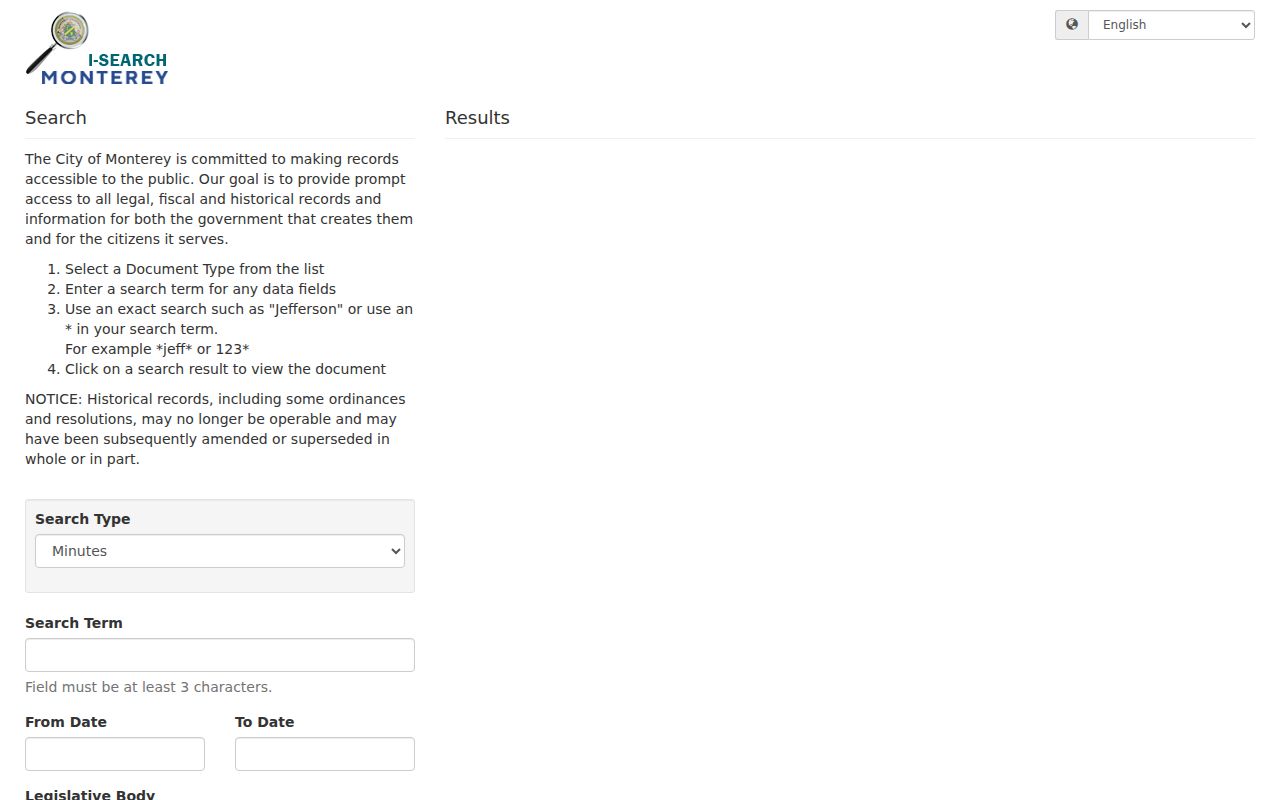
I-SEARCH results often lead to the City Clerk. The office sits at Few Memorial Hall, 580 Pacific Street, Room 6, 831-646-3935. Phone and written requests both work. A secure drop box sits opposite the Council Chamber ADA entrance. For permits, try the Permit Center and Building and Planning counter. It is at 580 Pacific Street, Room 1, 831-646-3799. The MyMonterey portal is account-oriented. Historic research may therefore require a property jacket, a Planning address file, or a narrow records request.
California's Public Records Act, the CPRA, backs you up. It applies when a useful series is not online. Describe the record and any address or name variants. Include the date range, custodian, and the electronic format you want. An agency ordinarily makes an initial disclosure determination within 10 calendar days. A written extension for unusual circumstances can add up to 14 more. Inspection is generally free, though duplication may be charged at direct cost. The CPRA deadline statute is the best reference for that timing.
Monterey Historical Directory Shelves
The historical Monterey residents directory is really a stack of dated printed listings. It is not one continuous roll. The California History Room holds city directories from 1905 to 1987. It also holds Haines reverse directories from 1970 forward, telephone directories from 1906 and from 1943 on, voting registers for 1867, 1879, and 1890, census material through 1950, Sanborn maps from 1885 to 1962, and newspapers from 1846 to 2001. A single directory year can place an adult at an address. It may show a spouse or a listed occupation. It can also hint at when a household moved. Omissions and gaps are part of working with the source. For a short search, start with a reverse directory for the address. Then try an alphabetical name entry, a nearby year, and a second source such as census, newspaper, deed, or Sanborn map. Use the Monterey city directories collection for the full shelf-by-shelf treatment.
Monterey Library Directory Years
The library's Polk run stands out for its specificity. The California History Room lists Polk's Monterey Peninsula directory: including Monterey, Carmel, Del Rey Oaks, Pacific Grove, Sand City and Seaside. The publisher is R. L. Polk & Co., call number 917.9476 POL[K]. Holdings include 1926, 1930, 1937, 1939, 1941, 1947, 1949, 1951, 1953, 1954/55, and 1956 through 1987. Only 1961, 1983/84, and 1986 are missing. Pacific Grove Library reportedly holds 1885 and 1933. Early county business directories cover 1875, 1877, 1882-83, and 1889. Haines, call number 917.9476 HAI, turns an address into a listed occupant from 1970 on. It later adds reverse phone material. Telephone books run from 1906 and 1943 forward. The shelf also holds Sanborn editions and corrections from 1888, 1892, 1905, 1912, 1924, 1926, 1936, 1943, 1956, and 1962. Newspapers and obituary files sit there too. Ask staff for the exact volume, the reverse section, and the abbreviation key. Also ask whether a gap means a missing volume or a missing entry.
The California History Room genealogy collection ties those printed directories to census, newspaper, and map holdings. Register holdings round out the set.
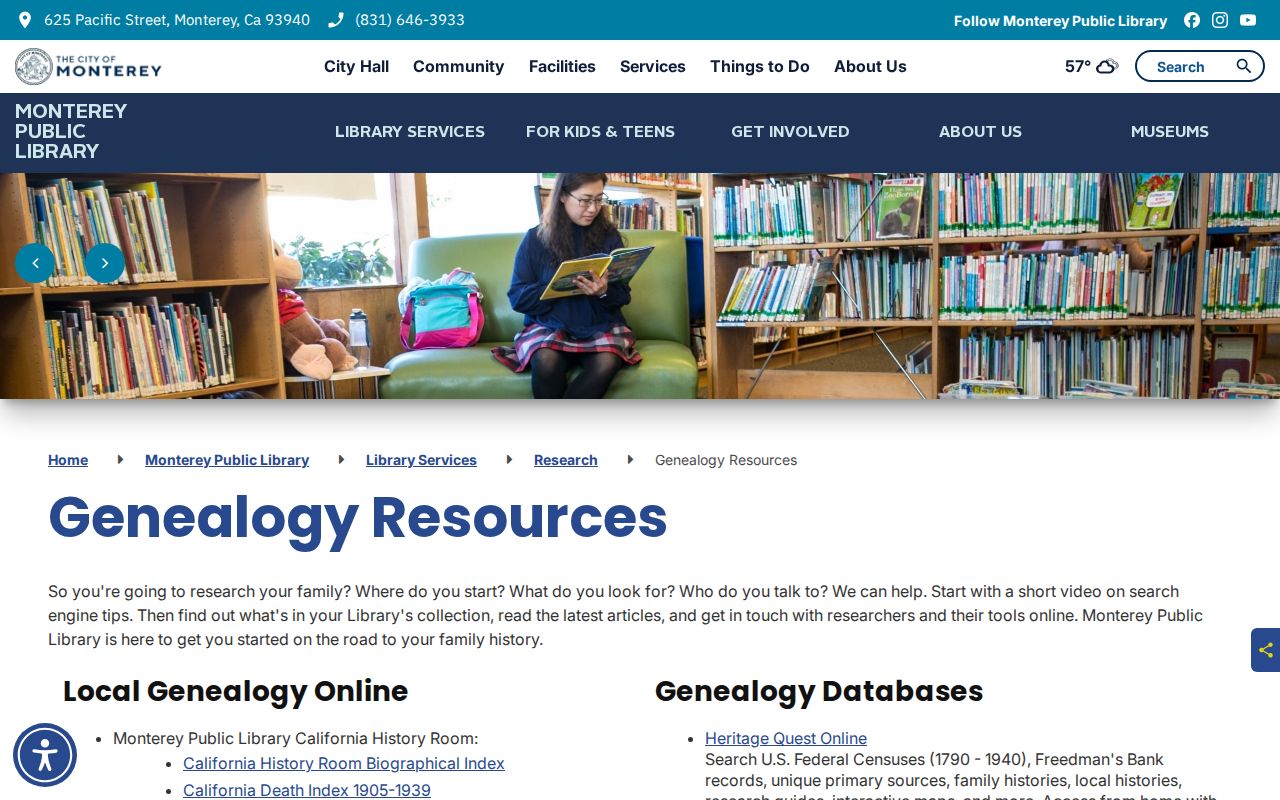
The library image points to a finding-aid route, not a claim that every directory has been digitized. The room is appointment-based and noncirculating. Ask for a targeted name, address, and year before you visit.
Monterey Business and License Records
A business question is often at the root of a resident question in Monterey. The California Secretary of State bizfile Online returns an entity name and number. It also gives registration date, status, jurisdiction, type, principal or mailing address, agent, Statements of Information, and the full filing history. Treat any principal or agent address as an address of record for the entity. It is not proof of where a person lives. Fictitious business name filings at the Monterey County level and City Finance license files run on separate local tracks. City Finance publishes no public license roster. A direct inquiry or a CPRA request may be the practical route. The California Secretary of State business search is a quick way to test a name, entity, or trade-name lead.
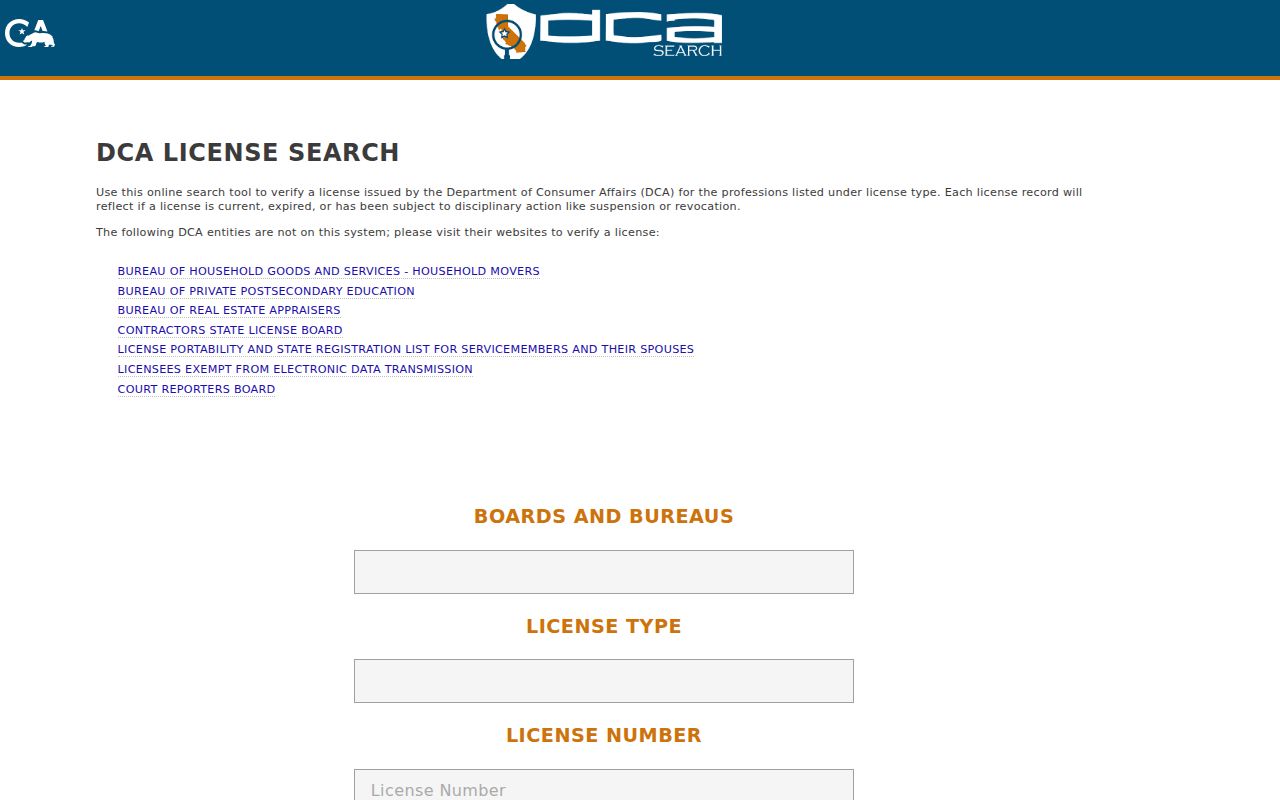
Filings prove a business tie. They do not turn an office, mailing, or service-company address into a home address. Orders from the Secretary of State can carry fees. Index and detail views are often free. The California DCA License Search adds one more narrow affiliation check. Its fields cover Board or Bureau, License Type, License Number, and Business Name. First Name, Last Name, City, County, and ZIP round out the options. A detail page may list licensee, number, type, status, and expiration. It can also show address of record and public disciplinary documents. The California DCA license search page shows that exact field pattern.
Used well, these records confirm a role, a business connection, or a dated public filing. They belong beside a Monterey resident lookup, never in place of an address, court, deed, directory, or vital record.
Monterey ZIP and Address Directory Clues
USPS ties Monterey to four ZIP codes, yet postal geography is not city jurisdiction. ZIP 93940 runs through the Monterey Post Office at 565 Hartnell Street. The same ZIP also serves the Cannery Row station at 686 Lighthouse Avenue. ZIP 93942 carries a Monterey association, but the USPS publishes no official station detail or PO-box-only status for it. ZIP 93943 belongs to the U.S. Naval Postgraduate School at 151 North Street. ZIP 93944 serves the Presidio of Monterey at 1712 Private Bolio Road.
The official lookup modes are ZIP by Address and ZIPs by City and State. A ZIP result alone never confirms that a person or company lives at an address. The GIS Parcel Report's City/Jurisdiction field is a stronger check for municipal boundaries. The NCIP map is another. Geography complicates things too. New Monterey and Cannery Row sit physically apart from the city core because the Presidio divides them, a genuine city-versus-federal split. The Monterey ZIP directory works through the ZIP-by-ZIP details.
- Resident roll
- A list made for one purpose, such as voter registration or taxation; it is not a complete population roster.
- Index
- A finding aid that points to a record, party, document number, or location; it is not always the legal record itself.
- Criss-cross directory
- A reverse directory that starts with an address and points toward a listed occupant or phone entry.
- Parcel and APN
- A parcel is a mapped land unit; its APN connects GIS, Assessor, Recorder, and legal-description clues.
- Situs address
- The physical location of land or a structure, which may differ from where mail is sent.
- Legal description
- The recorded land identity, often more stable than street text when an address changes.
Monterey Resident Address Privacy
Public-record work has legal and human limits. California Safe at Home covers qualifying survivors of domestic violence, stalking, sexual assault, human trafficking, and elder or dependent-adult abuse. It also covers qualifying reproductive-health participants. Each participant gets a confidential substitute mailing address with forwarding. It is an address-confidentiality program, not an Internet eraser. Copies already issued, unrelated web pages, or records under another custodian can persist.
State privacy rules also shape how a result is handled. The CCPA and CPRA grant rights to know or access, delete, correct, opt out of sale or sharing, and limit sensitive-data use. They also grant the right to avoid discrimination, and these rights apply against covered businesses. California DROP opened to consumers on January 1, 2026. Registered brokers began centralized deletion processing on August 1, 2026. Until a covered business acts, use its own privacy channel. Send only needed verification. Keep the confirmation, and recheck later.
Government Code section 27300 and related provisions allow SSN truncation and redaction in public recorded-document images, but a preserved original may survive with limited access. A missing online address never proves a record failed to exist. Use terms and confidentiality rules from the source itself govern the next step.
Monterey Records Before 1850
Monterey's resident record trail runs older than the county's own books. Monterey County formed in 1850 as one of California's original 27 counties. Spanish and Mexican records came first. Monterey served as California's first capital and hosted the 1849 constitutional convention. The Monterey County Historical Society keeps early material in the Robert B. Johnston Archival Vault, from Spanish military correspondence dating mainly to the 1780s and Mexican land-grant petitions to civil and criminal court material, immigration and military files, early-1850s county records, ranch maps, and nineteenth-century photographs.
Someone tied to an early Monterey family, land grant, adobe, institution, or business may find the regional archive more useful than a modern name lookup. The Monterey County historical-archives directory helps pinpoint a repository when the California History Room lacks a run. The Monterey History and Architecture Association (MHAA) advanced index searches an exact last name alongside role, building, organization, location, topic, publication, or notes. Its Noticias index spans 166 issues from 1957-2009, and Peninsula Diary holds 2,529 searchable Herald columns.
That early trail rewards careful source matching. A land petition, newspaper notice, directory listing, voting register, census entry, or deed may each light one corner of a life, and each carries its own date, purpose, and gaps. Keep the record date and custodian with every finding.