
Monterey Resident Records: What They Prove
A useful Monterey resident lookup starts by naming the question. A parcel record can locate an APN and a recorded-document clue, but it does not establish occupancy. A Recorder index identifies named parties to transactions, while a court index supplies case role and status. Directories, voter files, and vital records have different rules and different gaps. The coverage below keeps those distinctions visible before a search begins.
| Record | What It Confirms | Where | Access |
|---|---|---|---|
| Parcel/GIS | Property interest, APN, document clues | County GIS and Assessor | Not proof of occupancy; no web owner-name browse |
| Recorder | Named parties and transactions | 1850 to present indexes | Deeds concern ownership, not all residents |
| Court | Identity variants, case role, and status | Superior Court | Confidential and sealed limits |
| Voter | Own registration; qualified-file residence and status | Secretary of State and Elections | Not a general public lookup |
| Vital | Event linkage, death, and marriage | Health, Recorder, and CDPH | Copy eligibility; no modern open index |
| Directories | Listed adult, address, spouse, and occupation | Monterey Public Library | Era gaps and omissions |
| Business and licenses | Role, agent or address of record, and status | SOS, DCA, county, and city | Business address is not residence |
Use the narrowest source that matches the lead. An address or APN points toward GIS, the Assessor, and the two Recorder indexes. A possible case points toward the Monterey Superior Court. A death, marriage, or birth question moves to the custodian that holds that event by age. A professional or business clue belongs in the state license and entity systems. Two independent attributes, such as a name plus an address or a name plus a case role, are stronger than a single matching name.
Match a Monterey Resident Carefully
Names change shape in records. Normalize middle initials, shortened first names, married names, spelling variants, and punctuation before judging a result. The Monterey County Recorder warns that an online index resembles a library card catalog, not the official instrument. A missing result can reflect a date boundary, a handwritten historical page, a different spelling, or a restricted record. A match can also be wrong when two people share a name.
Anchor the name to a second fact before moving across systems. A directory year, neighborhood, known relative, court role, case date, parcel, or business affiliation can separate people with the same name. Do not treat an owner, agent, mail recipient, directory household head, or voter record as proof of every person at an address. The best Monterey name match keeps a note of the exact spelling, source, date range, result identifier, and whether the result was an index, an image, or a certified record.
Monterey Court Lookup Modes
The Monterey Superior Court Public Portal requires no login and supports case-number, party-name, and business-name searches. The real field rules matter. Case Number needs at least five characters. In party mode, First Name needs three characters and Last Name needs four. Business Name needs four characters. Add an asterisk for a wildcard, then use Search; Clear resets the form.
| Case Number | Text; required in case mode; minimum five characters; append * for a wildcard |
|---|---|
| First Name | Text; required in party mode; minimum three characters; append * for a wildcard |
| Last Name | Text; required in party mode; minimum four characters; append * for a wildcard |
| Business Name | Text; required in business mode; minimum four characters; append * for a wildcard |
| Clear | Button that clears the current query |
| Search | Button that runs the selected search mode |
| Items per page | Pagination control; the observed default is 10 results |
General current and completed case coverage reaches 2008 to present. Criminal electronic information reaches November 1992. A remote result can show the case number, case name, status, filing date, and case type. It may not show every document or every detail allowed at a courthouse terminal. Test a short last-name variant, then add the first name or case number when a common name produces too many matches.
The Monterey Superior Court case-search information page identifies the public access route described above. The captured court-search view below helps distinguish the official portal from an unrelated name-search service.
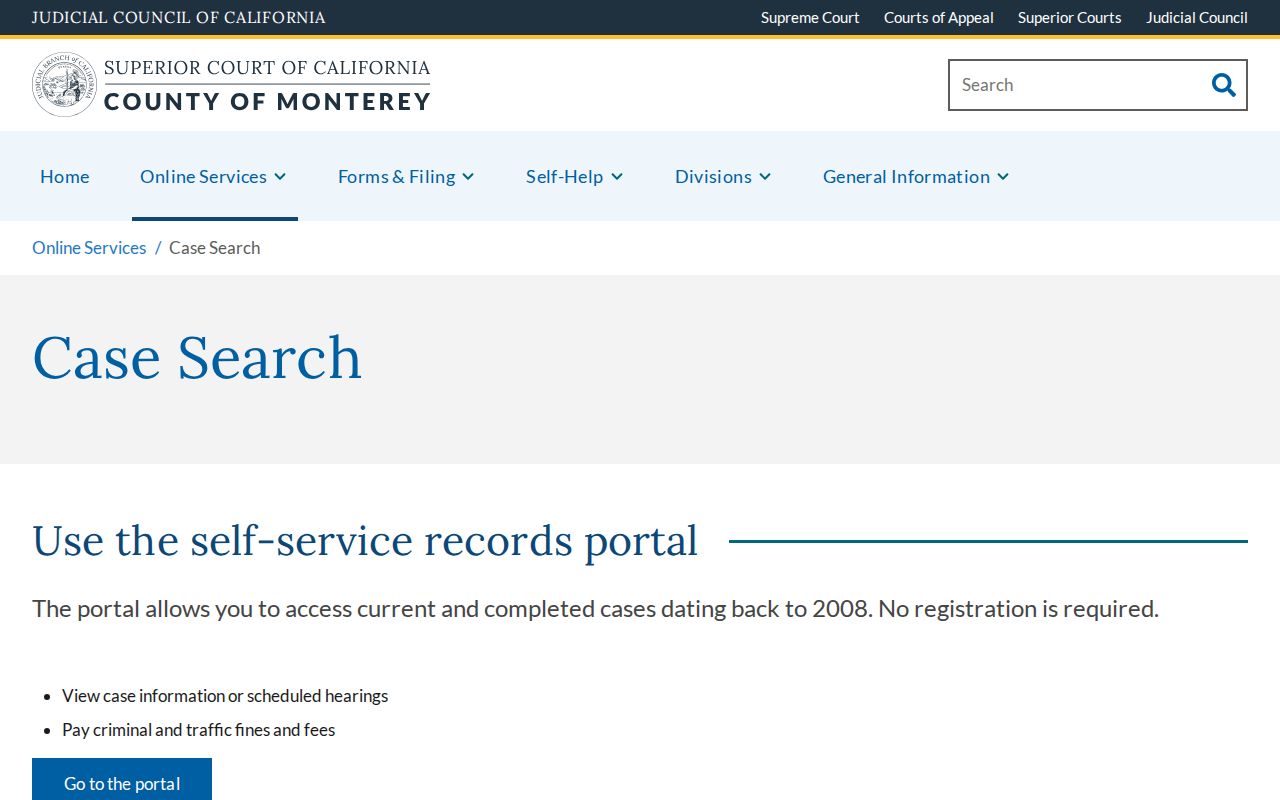
The portal is a starting index. Identity still needs a second attribute, and the court clerk remains the source for access questions, restricted material, and copies.
Monterey Resident Court Access
Insider tip. Courthouse computers can expose more than the remote screen. They provide permitted indexes, calendars, registers of action, and records that may not appear in the public portal. Civil, family, and probate minute orders from proceedings on or after July 9, 2012 can be viewed in the court viewing room. Self-research at a terminal is free. A clerk search costs $15 per name when applicable, or when the work takes more than ten minutes, and ordinary copies cost $0.50 per page.
Criminal records have their own path. For a matter before November 1992, visit the Salinas Courthouse clerk or use the court record-search process; the court does not perform criminal searches by telephone. Bring the case number or full name, plus date of birth, driver-license number, violation place or date, and other identifying facts when available. Staff can handle up to three searches while a person is present, while additional work may take up to 72 hours.
The criminal court records image below reflects a separate access channel from the no-login portal. It is useful when the name search needs an older case route or a counter request.
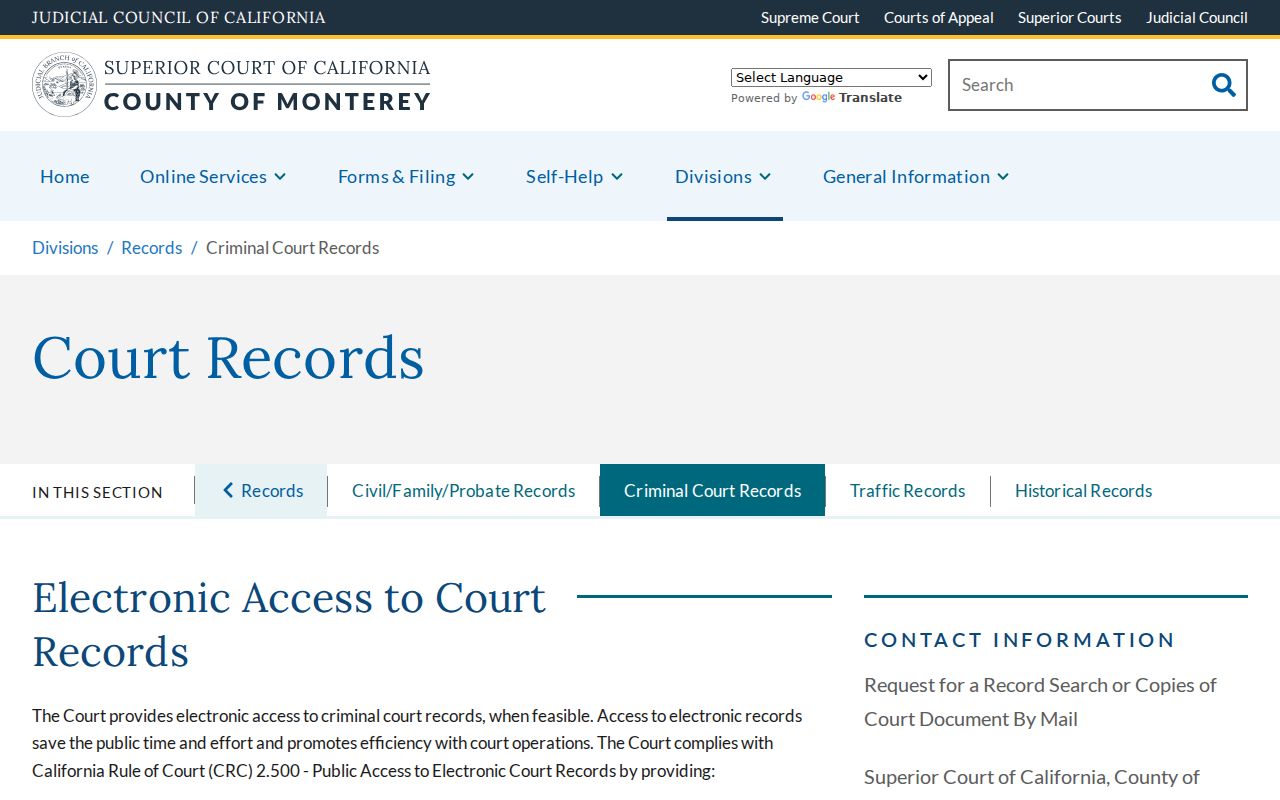
Criminal mail requests use the same identifying facts, a request form, check or money order, and a self-addressed stamped envelope. Mail Superior Court, Attention Records, 240 Church Street, Salinas, California 93901. When the amount is unclear, the court permits a check marked not to exceed $200 and fills in the actual charge within that authorization.
For civil, family, or probate searches, complete one CI-115 records request form for each search. The form asks for the requester, searched name, case number if known, filing period, desired documents, certification choice, delivery details, and signature.
The civil, family, and probate records office accepts the request by mail or in person, with fees paid in advance. Mail it to Superior Court, Attention Records, 1200 Aguajito Road, Monterey, California 93940, or visit on weekdays excluding holidays from 8:00 to 3:30. The court-request image below shows why a name, period, and document choice should be set out before mailing.
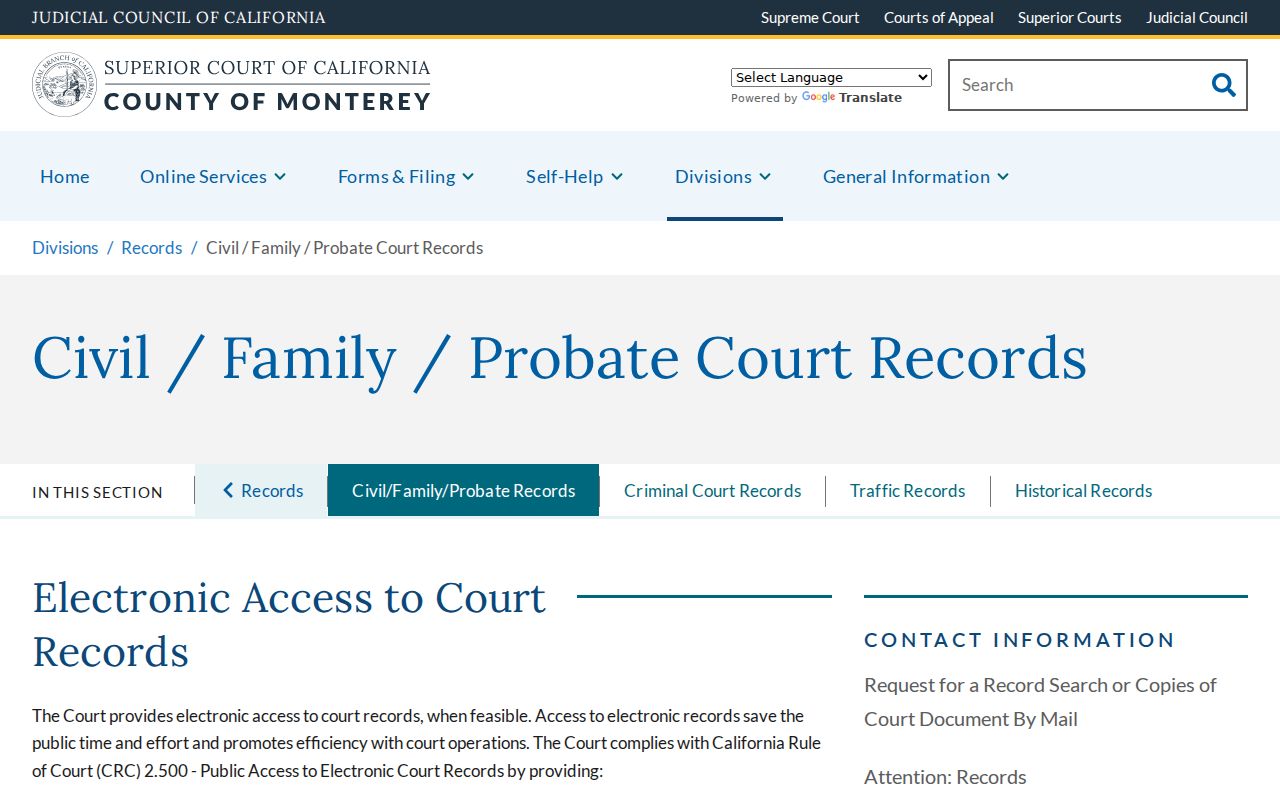
Adoption and paternity material is confidential. Party status with photo identification or a court order may be required. Juvenile, sealed, mental-health, and many family details are not general remote records.
Read Monterey Lookup Results
A court search result is an index entry, not automatically the whole case file. The result grid can contain the following fields:
- Case Number, the identifier used for later clerk requests.
- Case Name, which can reveal a caption but not every party relationship.
- Case Status, the court's displayed status field.
- Filing Date, which helps separate people with similar names.
- Case Type, which signals the general record category.
Case detail may add parties, the register of actions, and hearings, subject to the category and remote-access rules. A docket is the running record of case events, while a register of actions is the court's chronological entry list. An index is a searchable pointer. An image is the filed page or scanned document behind that pointer. A certified copy is a copy attested by the custodian for an accepted official purpose. These terms prevent a free name result from being mistaken for a complete or certified record.
Federal matters follow a separate path through the Northern District of California and PACER. An account is required. The charge is $0.10 per page, usually capped at $3 per document, and quarterly charges of $30 or less are waived. PACER does not replace the Monterey Superior Court search. For transferred, nonconfidential historical court files, the Monterey County Historical Society is another access route during normal hours, with duplication at cost.
The historical court records office explains the older-file route. The image below belongs with the distinction between a remote index, a courthouse viewing path, and a historical file held outside the online portal.
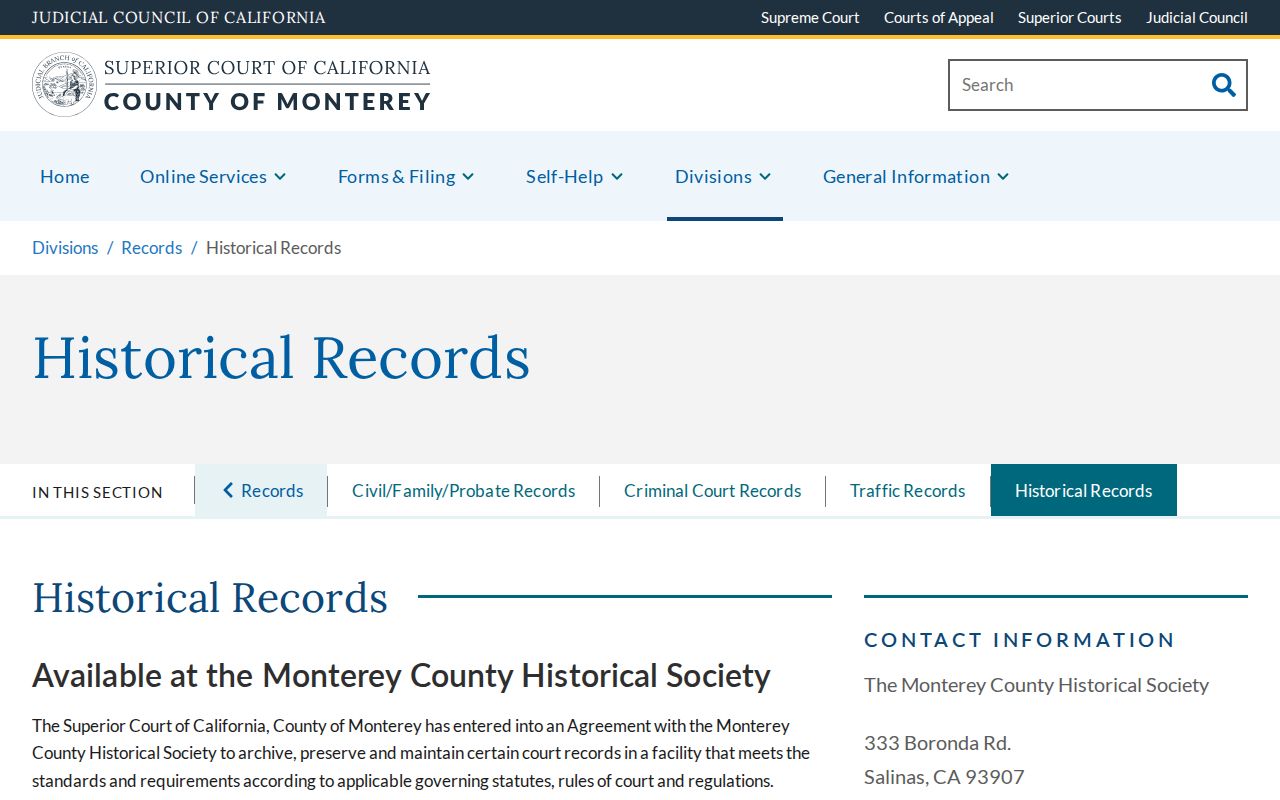
Preserve the case number, query spelling, search date, and visible status before ordering pages. That small record of provenance makes a later correction or custodian request more precise.
- Docket
- The chronological record of filings, hearings, orders, and other case activity.
- Index versus image
- The index points to a record; the image is the filed page or scan, when access rules permit viewing.
- Certified copy
- A custodian-attested copy whose certification carries official weight, unlike an ordinary screen print.
Monterey Vital Records Routing
Vital records do not have one open modern name index. Route the request by event and age. Monterey County Health, at 1270 Natividad Road in Salinas, holds the current year plus one prior year for births and deaths. Its counter is open Monday through Friday from 8:30 to 4:30, closes from noon to 1:00, and can be reached at 831-755-4504. The County Recorder at 168 West Alisal Street in Salinas holds older county births and deaths and county marriage records. The California Department of Public Health is the statewide custodian for its covered records and forms.
| Event | First local route | Copy and access rule |
|---|---|---|
| Birth | Health for the current year plus one prior year; Recorder for older county events; CDPH statewide | Authorized certified or informational copy; 2026 fee $31 |
| Death | Health for the current year plus one prior year; Recorder for older county events; CDPH statewide | Authorized certified or informational copy; 2026 fee $26 |
| Public marriage | Recorder or CDPH, depending on the record route | Authorized or informational request; 2026 county fee $19 |
| Confidential marriage | Recorder | No open index; access is limited under Family Code section 509 |
| Divorce | Superior Court | CDPH Certificate of Record for 1962 to June 1984 is not the decree |
The Monterey County vital-records route distinguishes authorized certified copies from informational copies under Health and Safety Code section 103526. Authorized categories include the registrant and close relationships, a court-authorized party, a government official acting in official business, and an authorized attorney or estate representative. Others may receive an informational copy marked not valid for identity, with statutory redactions. The California Department of Public Health supplies statewide forms and custody guidance.
Health accepts in-person orders while the requester waits and takes cash, check, or card. Mail requests use check or money order; mailed authorized copies need a notarized sworn statement. In-person authorized requests can use a web preapplication or office kiosk, then a photo ID and signature before staff. VitalChek adds $12.95 per transaction and uses online authentication or a notarized identity certificate. Adopted or legally name-changed birth records route to CDPH rather than the county's ordinary workflow. A search that fails can produce a certificate of search rather than a refund.
Confidential marriage copies require the party's identification or a court order. The public should not infer a family relationship from an unavailable certificate. The same care applies to a divorce: Superior Court holds pleadings, judgments, and the decree, while CDPH's limited Certificate of Record reports names, county, case number, and filing date without proving all decree terms.
Monterey Voter Lookup Is Self-Only
California My Voter Status is an authenticated self-check, not a public resident directory. The voter enters first and last name, date of birth, and a California driver-license or identification number or the last four digits of a Social Security number. A match can return registration status, party preference, county, polling or ballot information, and election details. Protected voters are excluded. A failed match does not prove nonresidence because an input can differ, a registration can be inactive, or the record can be protected.
Myth check. A voter-status screen cannot be used to browse a Monterey block or produce a list of neighbors. The broader file is released only through a qualified-purpose application under Elections Code sections 2188 and 2194.
Monterey County's seven-page voter-file application asks for the applicant, organization, beneficiary, intended use, security plan, purpose category, specific voter or geography, voting-history choice, delivery format, signature, and identification. Routes include fax, email, mail, and hand delivery to 1441 Schilling Place, North Building, Salinas 93901. Questions go to Elections at 831-796-1499 or MCEData@countyofmonterey.gov. A clear valid driver-license or state-ID copy, an original signature, and supporting purpose documents are required. Up to ten specified voters can be included on one application.
A separate California statewide file request costs $100. A specific-voter request costs $30 per person, capped at $100 for ten people. Approved election, scholarly, journalistic, political, and governmental purposes apply, and the data cannot be transferred, exported, or published in an insecure way.
Delivery is a secure thumb drive or a secure downloadable tab-delimited text file. The county quotes the price after reviewing the request and aims for two to three business days. Geography can be countywide, a district, a city, or listed precincts. Voting History records whether and how a person voted, never the ballot choice. Potential fields include name, residence or mailing address, contact fields, language, birth date, gender, party, status dates, precinct, districts, and participation, but the exact file depends on the approved request. Driver-license data, Social Security numbers, and signatures are not released.
Historical Great Registers at Monterey Public Library for 1867, 1879, and 1890 can help with genealogy. They represent limited historical electorates, not a current population list. Commercial use, unauthorized transfer, insecure publication, and harassment are barred, and knowing unauthorized use can be a misdemeanor under Elections Code section 18109.
Monterey Name-to-Address Check
A name-to-address check should move through parcel evidence without claiming more than the record says. The open Monterey County GIS layer can locate an address or APN, show legal and district clues, and select adjoining geography. It omits owner and mailing-address fields. The Assessor's free Value Notice search is keyed to a Fee Parcel Number or Assessment Number, not a public owner-name browse. The Recorder then supplies named parties and instruments, while the County Surveyor stabilizes a legal description when a street label has changed.
Use the following order when a current name needs a place-based verification:
- Normalize the name, then record the known year, neighborhood, relative, case clue, or business connection.
- Locate the address in the Monterey County Parcel Report viewer. Address search returns at most six suggestions, APN search supports partial matching with at most six results, and selection tools can return up to 2,000 parcel records.
- Carry the APN into the Assessor system. The number box accepts 12 digits or at least six partial digits without punctuation. The public output can include ownership, parcel status, tax-rate area, assessed values, exemptions, and characteristics, but it is not a title warranty or a current condition report.
- Search the Recorder's current and historical indexes. The current index covers 1978 to present; the historical index covers 1850 to 1977. Test every party spelling, then connect the seller as an earlier grantee while checking the APN and legal description.
- Confirm the result with a second independent clue, such as a directory entry, court role, obituary, business filing, or vital-event linkage. Treat an owner or deed party as an ownership clue, not proof that every resident lived there.
The Recorder counter is at 168 West Alisal Street, first floor, Salinas, open Monday through Friday from 8:00 to 5:00, and reachable at 831-755-5041. Mail requests go to PO Box 29, Salinas 93902, and should include the document number or reel and page, recording year, at least one exact indexed party, and document type. Copies are $2 per page and certification is $2 per document. The Assessor can be reached at 831-755-5035; residential characteristics reports cost $24, with map prints and screen copies available for separate fees. The Surveyor keeps parcel maps, subdivision maps, records of survey, and corner records dating to 1850. Tax Collector records are a separate parcel and tax channel, not evidence that the taxpayer occupies the property.
When the question shifts from one resident to everyone connected with a street, the Monterey street directory route keeps the address work separate from this name-first workflow.
Historical Monterey Resident Sources
Older resident trails often need a library shelf rather than a modern search box. Monterey Public Library's California History Room genealogy resources hold city directories from 1905 to 1987, the Polk Peninsula series with verified gaps, Haines criss-cross directories from 1970 to current holdings, telephone books from 1906 and 1943 to current holdings, census material through 1950, voting registers, newspapers, maps, and obituary files. The room is appointment-only, quiet-study, and noncirculating. Staff can point to a volume or provide limited remote reference, but do not promise a complete family reconstruction.
For a former classmate, use only verified Monterey High yearbook years. For an heir, pair probate with an obituary and name the surviving relatives rather than relying on one directory line. For a birth-parent question, use the official state or court procedure because adoption material and related vital files are confidential. The 1875 L. L. Paulson county handbook-directory has 455 pages and maps in the FamilySearch catalog, while the 1889 county directory and local genealogy indexes add earlier adult names. These are finding aids or published compilations, not modern certified copies.
The reverse method is practical: find the street and address in Haines, copy the entry exactly, move to the alphabetical name section for spouse and occupation, scan nearby addresses, and repeat in adjacent editions. Bridge gaps with telephone books and the 1950 census. Sanborn editions and corrections from 1885 through 1962 can reconcile an old street number or building footprint. Newspapers run from 1846 through 2001 online, with later Monterey County Herald material and obituary indexes extending beyond that range. The Monterey Historical Association advanced index is useful for an exact last name paired with a role, building, organization, or place. Its Noticias index covers 166 issues from 1957 to 2009, and Peninsula Diary links searchable text to 2,529 columns.
Historical material can confirm that an adult was listed, photographed, mentioned, or counted at a time. It cannot fill every gap between editions. A directory omission, a changed street name, an unlisted household member, and a private or protected address all remain possible. The Monterey city directory collections carry the fuller volume-by-volume method for that historical trail.
Monterey Business Records Clues
Business and license records can help distinguish two people with the same name, but they prove affiliation rather than residence. California DCA's umbrella search accepts a board or bureau, license type or number, business name, first name, last name, city, county, and ZIP. A detail can show the licensee, status, expiration, address of record, and public discipline documents where applicable. Board systems add their own fields. SOS business records show entity roles, principal or mailing information, agent information, and filing dates. A statement of information establishes a filed role or date, not where a person lives.
For a Monterey trade name, use the County fictitious-business-name route. City Finance keeps a separate license file at 735 Pacific Street, with direct inquiry or a narrow records request as the fallback because no official public licensee roster was verified. The City Clerk's records system can add a named party or business document. Keep the business address apart from a residential conclusion, especially when an agent, service company, or mailing address appears in the filing.
The State Controller's unclaimed-property search is another name clue. A surname or business name is required, while first name and city are optional. A result can show a reported owner, address, property ID or type, reporting company, and amount category. The search and claim are free, and the Controller's claim process establishes entitlement. The captured result below belongs to that state channel, not to a Monterey residency roll.
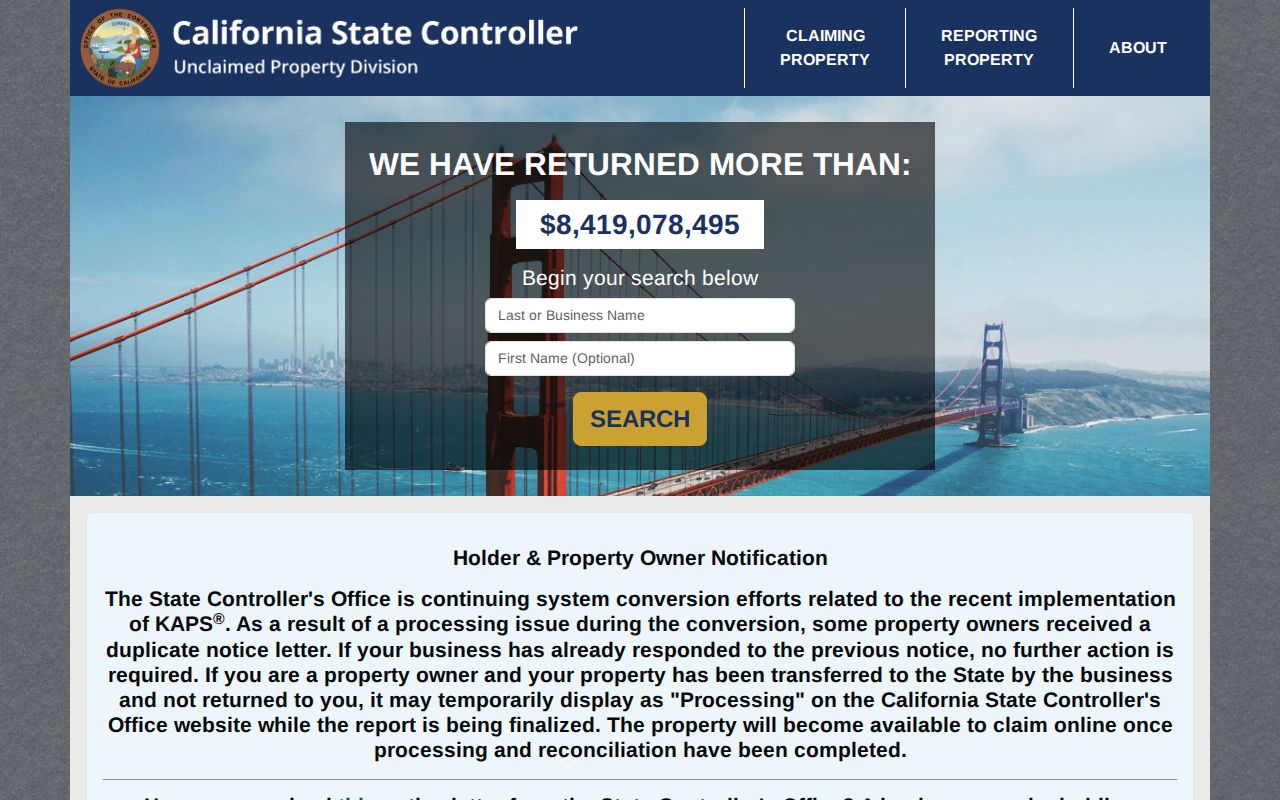
Use the result to generate a question for the proper custodian. Do not treat a reported address, business role, or property claim as proof that the named person currently lives in Monterey.
Monterey Resident Custodian Requests
When a portal stops at an index, ask the office that created or holds the record. The California Public Records Act, Government Code division 10, sections 7920.000 through 7931.000, permits any person to request disclosable records. An agency ordinarily makes an initial determination within ten calendar days and can use a written unusual-circumstances extension of up to fourteen days under section 7922.535. Inspection is generally free; duplication can be charged at direct cost. A narrow request names the record series, date range, custodian, person or address variants, and preferred electronic format.
Monterey City Clerk records can be searched through the free I-SEARCH portal using a document type, indexed term, exact text, or an asterisk wildcard. Its dynamic document-type list and full coverage dates were not exposed, so the Clerk is the fallback. The office is in Few Memorial Hall Room 6, 580 Pacific Street, and accepts phone or written requests. Phone and email hours are 8:00 to noon and 1:00 to 5:00; in-person visits are by appointment, and a secure drop box is opposite the Council Chamber ADA entrance.
Permit and planning records require a different channel. The Permit Center is at 580 Pacific Street, Room 1, and the account-oriented MyMonterey portal does not have a verified anonymous historic search in the research. Ask Building Safety for a property jacket or send a focused request. Planning address files at the Colton Hall ground floor, 570 Pacific Street, may add variances, use permits, blueprints, reports, minutes, and owner references. A directory or newspaper correction should go to its publisher or library custodian; a court identity collision should include the case number and identifying facts for the Clerk; a voter-status correction belongs with Elections.
For a mailed court search, use the CI-115 process and identify the documents before payment. For vital records, use the right application and copy category. For a directory, distinguish a bad OCR transcription from the scanned page. The custodian can correct or explain its own record, while a name-search result from another source cannot establish that a disputed detail is true.
Monterey Resident Lookup Limits
Privacy rules shape a Monterey name search at every stage. Safe at Home provides a confidential substitute mailing address and mail forwarding for qualifying survivors of domestic violence, stalking, sexual assault, human trafficking, elder or dependent-adult abuse, and qualifying reproductive-health participants. It is not an Internet eraser. Existing copies, unrelated web pages, and records held outside the program can remain. Recorded-document Social Security number remedies under Government Code section 27300 and related provisions can truncate or redact public images while preserving the original under limited access rules.
California CCPA and CPRA rights include access, deletion, correction, opt-out of sale or sharing, limits on sensitive-data use, and non-discrimination for covered businesses. California DROP opened its consumer interface on January 1, 2026, and registered data brokers begin processing centralized deletion directions on August 1, 2026. Until broker processing begins, use each covered business's own request route, send only needed verification, save confirmations, and check again. A court, voter, vital, or protected-address rule still controls the custodian record.
Lawful personal use. A Monterey name search belongs to proportionate, lawful research such as genealogy, reconnecting, estate work, record correction, or consumer-scam avoidance. Do not use records to stalk, harass, threaten, intimidate, or publish sensitive addresses. California laws addressing stalking, criminal threats, identifying-information harassment, civil-harassment orders, voter misuse, and misuse of statutory offender information can carry serious consequences.
Before relying on a result, preserve the portal URL, access date, query spelling, coverage statement, record identifier, and image or copy status. A negative result is meaningful only after checking the date range, spelling rules, restricted categories, geographic custodian, and offline fallback. That discipline keeps the result useful without turning a limited public record into a claim about a private person.