
Monterey City Directory Holdings
Monterey Public Library's California History Room serves as the central local shelf for these materials. City directories sit there. So do phone books, voting registers, and Sanborn maps. Reverse directories, census material, and newspapers round out the shelf. The Polk run earns its keep by crossing town lines. It names Monterey, Carmel, Del Rey Oaks, Pacific Grove, Sand City, and Seaside in a single set of volumes. Older county and business titles widen the search before that regular series begins.
| Collection | Years | Publisher | Where held | Access |
|---|---|---|---|---|
| Monterey city directories | 1905-1987 | Printed local issues | California History Room | Appointment, noncirculating |
| Polk's Monterey Peninsula directory | 1926, 1930, 1937, 1939, 1941, 1947, 1949, 1951, 1953, 1954/55, 1956-1987 except 1961, 1983/84, 1986 | R. L. Polk & Co. | California History Room | Call 917.9476 POL[K] |
| Early county and business directories | 1875, 1877, 1882-83, 1889 | L. L. Paulson and local compilations | FamilySearch and local libraries | Catalog, center, or room access |
| Pacific Grove reported holdings | 1885, 1933 | Publisher not confirmed | Pacific Grove Library | Verify local availability |
| Haines criss-cross directory | 1970-current | Haines & Co. | California History Room | In-person address and phone reverse |
| Telephone directories | 1906; 1943-current | Telephone publishers | California History Room | In-person, noncirculating |
The Polk year list describes holdings, not printing history. A missing volume was not necessarily never issued. The gaps at 1961, 1983/84, and 1986 simply mark years the shelf does not hold. A search that quits at one absent year can miss a neighboring issue, an early county directory, or a Haines and phone-book overlap covering the same address. Missing years call for detours, not conclusions.
Monterey City Directory Access
Access runs through the California History Room. The room is appointment-only, quiet-study, and noncirculating. Call 831-646-2091 before a visit and give staff the name, address, and year range that matter. Guidance and limited remote reference are available. Staff do not sell a full genealogical research service. The library's genealogy resources page is the online starting point. It covers its directory, census, voting-register, telephone, reverse-directory, and Sanborn holdings.
At the room, personal nonflash photographs and careful copies are permitted. An item's condition and copyright decide what is allowed. Label every image with title, year, page, and call number. The catalog also reaches material tied to Monterey Public Library, Colton Hall Museum, Mayo Hayes O'Donnell Library, and Pacific Grove historical collections. A catalog result may point to a different reading room, so follow the location note.
The California History Room collection page describes the local-history setting behind these holdings. Read it before requesting a nonloan volume.
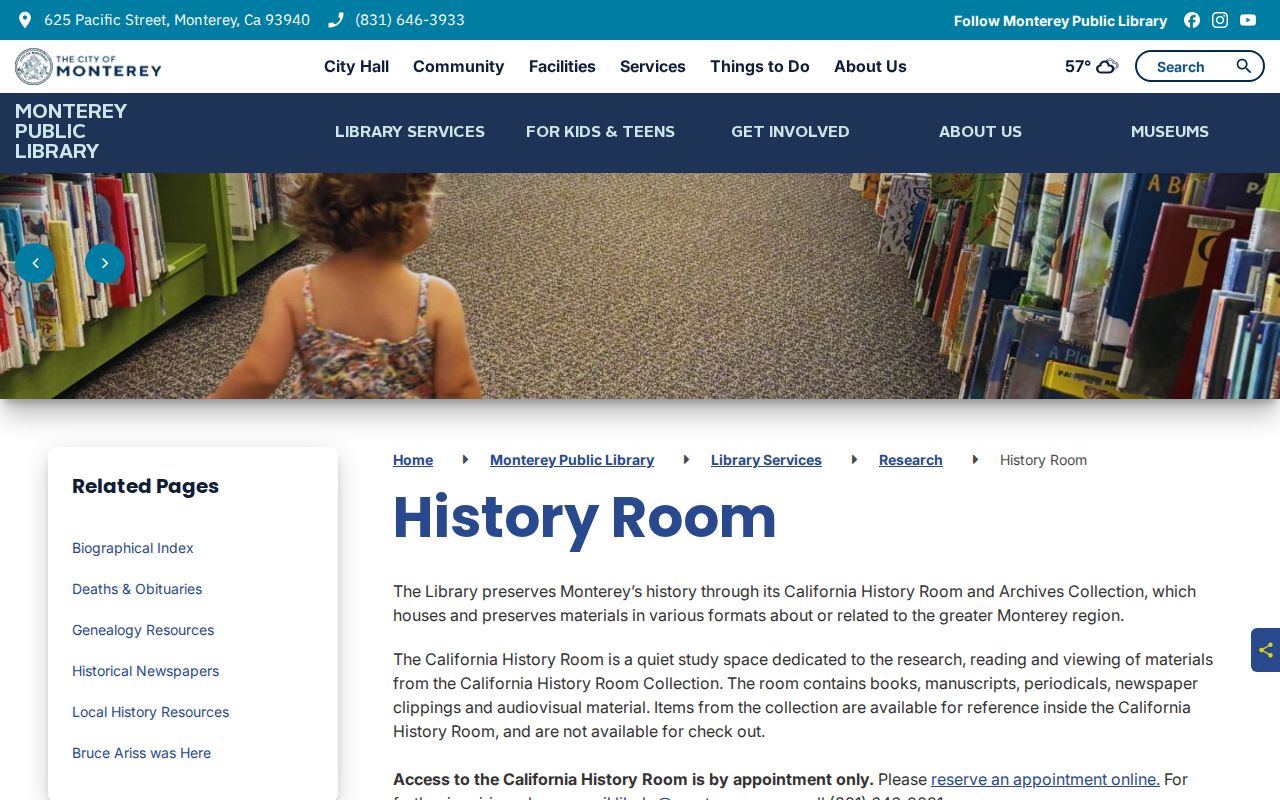
The collection page describes the room itself. The bound volumes still supply the page-level evidence. Confirm access for the exact year rather than assuming a broad catalog label puts the full run on an open shelf.
[INSIDER TIP] Ask for the title page and abbreviation key before copying a name entry. Those two pages preserve the volume's own scope, symbols, and publisher wording.
Polk Monterey City Directories
The Polk Peninsula series anchors the twentieth-century holdings. Its full title reads “Polk's Monterey Peninsula directory: including Monterey, Carmel, Del Rey Oaks, Pacific Grove, Sand City and Seaside.” The call number is 917.9476 POL[K]. A name can surface under Carmel or Seaside even when the search starts in Monterey. Compare one household across the listed years. When a name entry points to a different address, check the street-order section too.
Longer trails need earlier volumes. California and Monterey County business directories are reported for 1875, 1877, 1882-83, and 1889. L. L. Paulson's 1875 county directory runs 455 pages. FamilySearch carries it under catalog number 3736235. The catalog may require sign-in or access through a FamilySearch Center, so treat the entry as a location and access clue until the page images can be viewed. It helps place a person before the History Room's 1905 city-directory run begins.
The FamilySearch catalog record for the 1875 Monterey directory supplies the key link to that early volume. A later Polk issue is often the likelier match. Paulson still reaches the families who predate it.
A catalog record is only a lead. The printed page still does the work. Pacific Grove Library reportedly holds directories for 1885 and 1933 as well, so confirm those local holdings when the early trail sits outside the Polk years.
Haines Cross-Checks Monterey Directories
Haines flips the search around. The “Haines Monterey, San Benito, Santa Cruz city & suburban criss-cross directory” is held for 1970 to the present under call number 917.9476 HAI. Start with the street and number, then move to that person's alphabetical entry for the rest of the record. Later Haines volumes also reverse phone numbers. That second route helps when a name is known but the address is not.
Telephone books stretch the comparison further. Monterey holdings begin with 1906 and continue from 1943 to the current run. A phone book bridges a missing Polk year. Haines shows the address-to-occupant path from 1970 onward. The sources overlap, yet they answer different questions, since a printed listing may name a household head, a business, or a phone subscriber rather than everyone at an address.
The reverse section has its own workflow. Find the printed address and copy the entry exactly as it appears. Verify the name in the alphabetical half. Adjacent addresses add block context. A changed street number deserves a check against a Sanborn sheet or legal description before two entries count as one household.
Reading Monterey City Directory Entries
Think of a Monterey city directory entry as a bundle of clues. It is not a tidy modern roster. The alphabetical part can tie a name to a spouse, an occupation, and an address. The reverse section works the other way around. It starts with the street. When you transcribe, keep the spelling, initials, punctuation, and short forms exactly as printed. Add a plain-language note beside your copy so the original wording stays intact.
| Resident name | Alphabetical name as printed, often the listed head of household or subscriber. |
|---|---|
| Spouse | A spouse may be printed beside the name when that volume records the relationship. |
| Occupation | Trade, office, or business role when the entry supplies it. |
| Street address | House number and street used to match the reverse section and nearby entries. |
| Owner/renter mark | Check the volume's own key. A uniform Monterey symbol has not been confirmed across the runs. |
| Other notation | Widow or other status notes may be useful, but verify each mark from that edition's key. |
- Criss-cross directory
- An address-ordered section that turns a street and number into a listed occupant; Haines is the local example.
- Householder index
- An alphabetical path centered on a listed person or household head, not a count of every person present.
- Abbreviation key
- The volume's guide to short forms and symbols. Photograph or transcribe it before interpreting an owner, renter, occupation, or widow notation.
Always read the reverse line and the alphabetical line as one pair. The first anchors the place. The second adds the person. If one half of the pair is missing, record that gap in your note instead of papering over it with a guess.
[MYTH] A city directory is not a complete resident roll. Monterey research has not located a universally reliable scanned entry or key, and the local holdings themselves warn against treating one listing as proof of continuous occupancy.
Monterey Directory Companion Sources
A one-line directory entry rarely tells the whole story. Historical association material can fill in the setting. The MHAA catalog by collection gathers named manuscript, photograph, publication, maritime, postcard, and Hotel Del Monte groups into one place. Search for a person, a building, or an organization. Then compare its date and address against the printed directory. That check confirms the connection is solid.
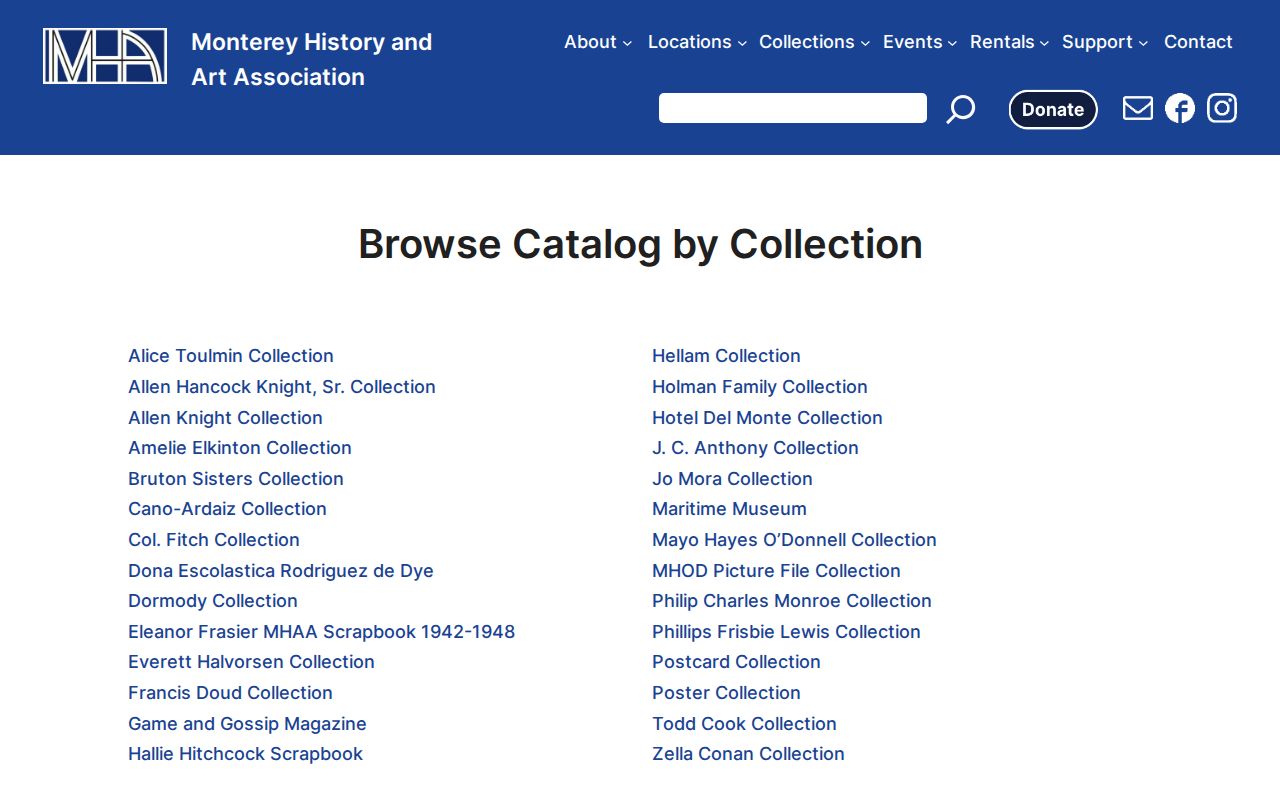
The catalog shows why a directory search can reach past a name and a street. A collection may hold photographs or papers that explain a building or a group. Still, a date and place must match before you attach any of it to one resident. MHAA's advanced index offers Name, Exact Last Name, Role, Building, Organization, Location, Topic, Publication, and Notes fields. Every field is optional. A quoted phrase can narrow results fast. Coverage includes 166 issues of Noticias from 1957-2009 plus 2,529 full-text Peninsula Diary columns from 1949-1970.
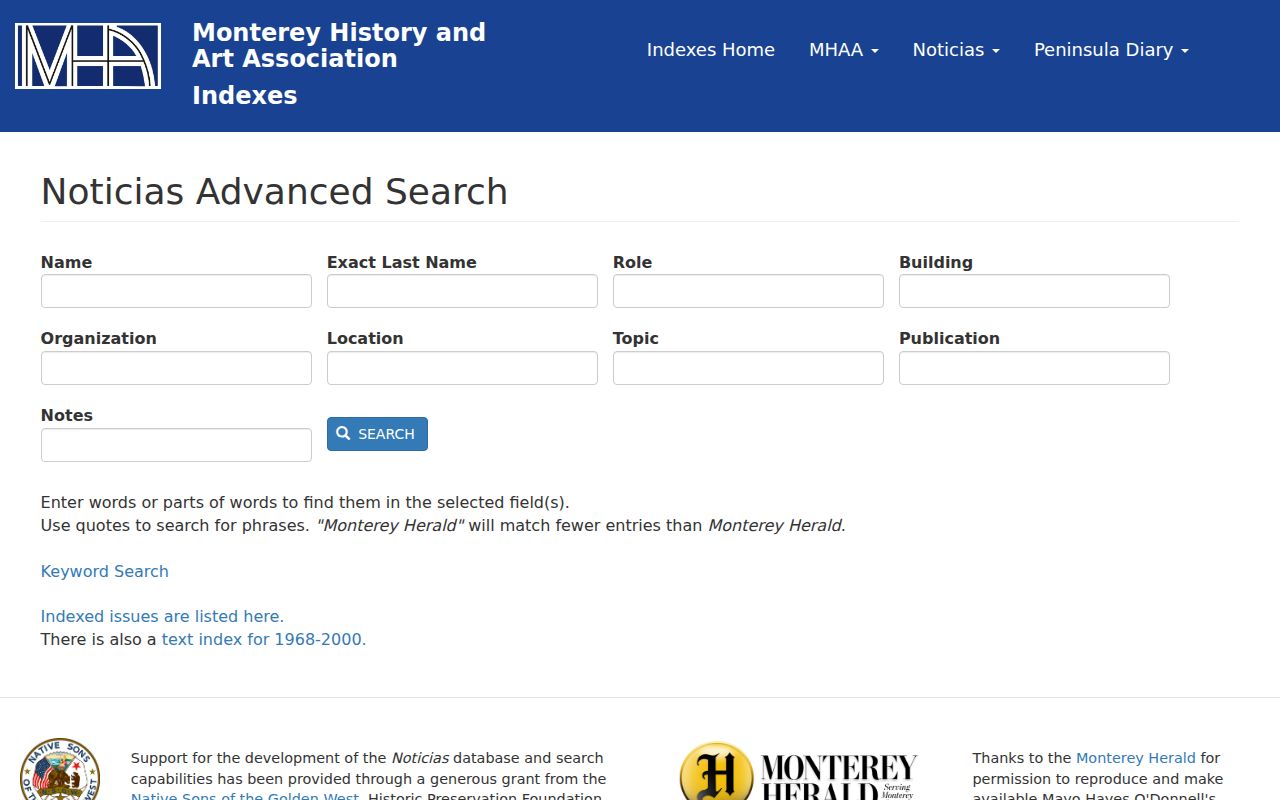
Pairing Exact Last Name with Role, Building, or Organization is the practical trick. It separates a common name from its specific Monterey setting before you read the directory entry. For a classmate trail, Monterey High's El Susurro is confirmed for 1913 and 1929 at Monterey Public Library and Colton Hall, with 1919-20 and 1925 at Mayo Hayes O'Donnell Library. Treat those years as evidence. They are not a complete yearbook run.
Trace a Monterey Directory Household
Family history rewards a dated sequence, not one impressive find. Pick a target year and address. Pair each directory issue with a census year. Another source can test the same household as well. Federal census material is public through 1950. The local library holds earlier federal and state-census material too. Voting registers for 1867, 1879, and 1890 can add an adult-place clue. They are historical registers rather than full population rolls.
- Set the starting point. Write the name, middle initial, street spelling, and known year. Record whether the clue came from a Polk, Haines, phone, newspaper, or family source.
- Search by address first when possible. Use the reverse section for the target street, then inspect the alphabetical entry for the listed name, spouse, occupation, and address.
- Repeat nearby years. Compare the next and prior available issues, including phone books when a Polk year is missing. Note moves, altered numbers, and a change in occupation.
- Bridge the census gap. Compare the directory trail with the 1850-1950 federal census material and the 1852 state census where it fits. A census household and a directory listing are related evidence, not identical records.
- Close the trail with place and event sources. Test a changed address against Sanborn maps and legal descriptions, then use newspapers, obituary indexes, probate, or a historical collection for a date and relationship clue.
A name that vanishes may mean many things. A missing volume, a move, an omitted listing, a changed street number, or a death could all explain it. Any one of these could be the cause. Hold off on picking one until the adjacent edition, a map, an obituary, or another custodian record backs it up. When a historic entry needs a modern identity match, the Monterey Resident Search workflow adds a separate record check. It does not replace the printed source.
Note: Preserve the exact citation, page image or transcription, search date, and coverage statement for every negative result.
Monterey Newspapers After Directories
Newspapers answer questions a directory cannot. Monterey local newspapers run online from 1846 through December 2001. The Monterey County Herald carries full text from 2002-current. Its page images run from 2023-current. Search by name, date, address, or event, then open the page image itself. OCR can split or distort a surname.
The History Room historical-newspapers page is the source for the local digital newspaper route. It ties newspaper access to the same research room that holds the printed directories.
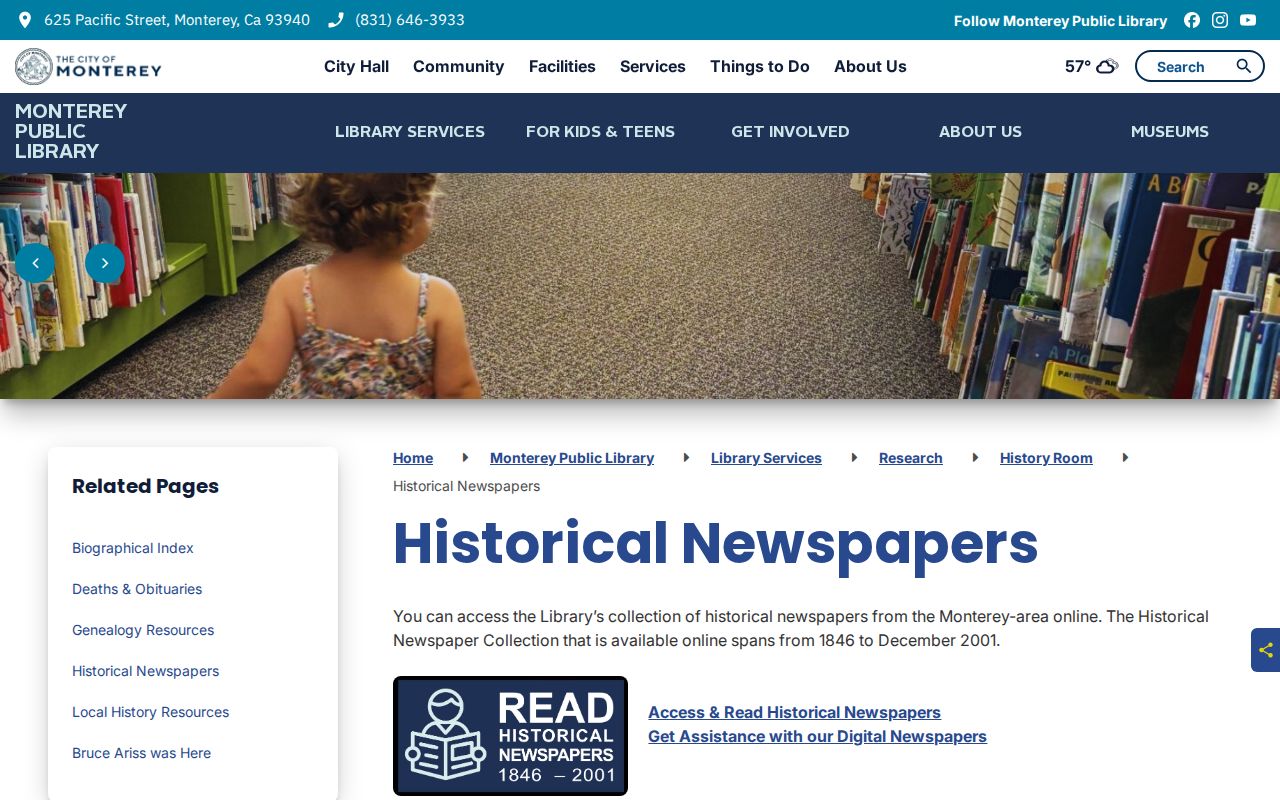
Set the newspaper beside the directory evidence rather than in place of it. A directory places a person at a street in a given year. A notice, story, or obituary may add a move. It may also give a death date, a relationship, or a community role. Local obituary finding aids cover January 1995-June 2003 broadly, with later material continuing afterward. Compilations reach back to 1840-1890, 1900-1960, and 1960-2013 or later. Use those spans to pick the next source after a last directory appearance. Remember that an index entry is only a finding aid. It is not the complete newspaper page.
Maps for Monterey Directory Addresses
Sanborn fire-insurance maps solve the address problems that can break a directory trail. Monterey holdings run 1885-1926 with updates through 1962. Known editions and corrections include several. They cover 1888, 1892, 1905, 1912, 1924, 1926, 1936, 1943, 1956, and 1962. A map can show a structure's footprint, use, and number continuity. It will not name every occupant. The Library of Congress 1912 Monterey Sanborn map record describes a 26-sheet digitized set. The 1943 map is reportedly known only at the Census Bureau in Indiana. So a missing local copy does not prove no edition existed. When a printed address changes, compare the directory line against a Sanborn first-sheet correction index and a parcel legal description. Also check the county's current parcel identity. The stable match may be the building or land description rather than the street text. For present-day address-keyed parcel work, the By Street workflow keeps the current GIS and deed trail separate from the historical shelf.
Monterey City Directory Timeline
The California History Room comes first for most researchers. When it lacks an issue, though, the County Historical Archives Directory serves as the regional fallback. It points searchers toward other repositories with Monterey holdings. The Mayo Hayes O'Donnell Library at 155 Van Buren Street, 831-322-6072, keeps noncirculating Monterey books. It also holds photographs, scrapbooks, and artifacts. Hours run Wednesday through Sunday, 1:30 to 4, or by appointment. In Seaside, the FamilySearch Center at 1024 Noche Buena Street, 831-917-1034, offers public computers, scanners, local help, and classes. Classes fall on Tuesday and Thursday afternoons from 1:30 to 4:30. Appointments are available too.
Several specialized collections round out the picture. NPS Special Collections, reachable at 831-656-2947 or ask@nps.libanswers.com, handles Hotel Del Monte material. It also covers institutional, military, and maritime holdings. CSUMB Archives welcomes general researchers working on university, Fort Ord, and community collections at archives@csumb.edu. Formats, identification rules, and handling requirements can all limit access. Before traveling, describe the person, place, and date you are chasing. Named-person sources sometimes surface in unexpected places. The NPS account of the rediscovered 1920s Hotel Del Monte register shows the value of an unexpected find. A guest register outside a standard directory can still solve a lookup.
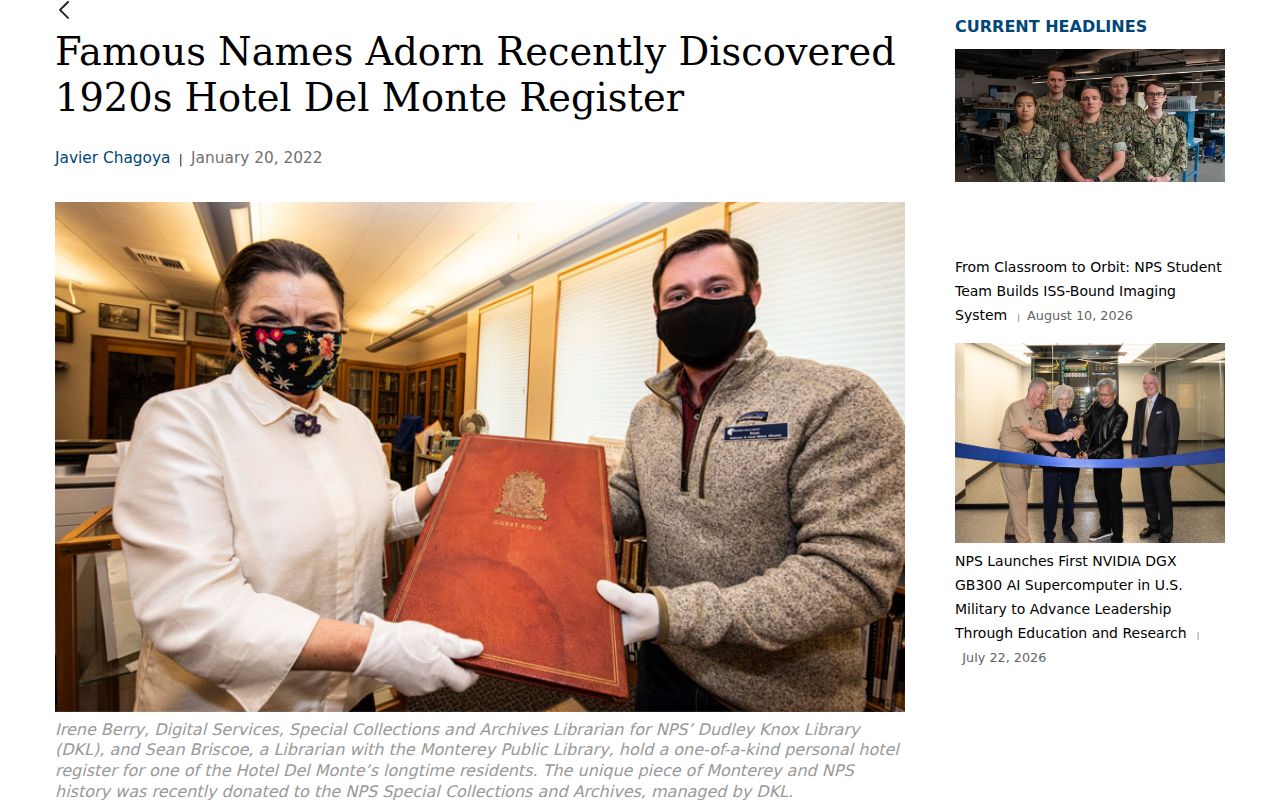
The register image proves a wider point about local archives. A guest book or institutional record can pin a directory name to a precise place and moment. Still, the match only holds when the date and the setting line up with the directory entry.
| 1875 | L. L. Paulson's 455-page county directory is cataloged for FamilySearch. |
|---|---|
| 1905 | The California History Room's Monterey city directory run begins. |
| 1906 | Telephone-directory holdings begin in the local collection. |
| 1970 | Haines Monterey, San Benito, Santa Cruz criss-cross coverage begins. |
| 1987 | The reported California History Room city-directory run ends. |
| 2002 | Monterey County Herald full-text coverage begins after the earlier newspaper run. |
That sequence keeps a lookup anchored to the source's own dates. Save the year, page, publisher, and repository together as one bundle. Then test the entry against the next available record rather than treating it as a final answer.